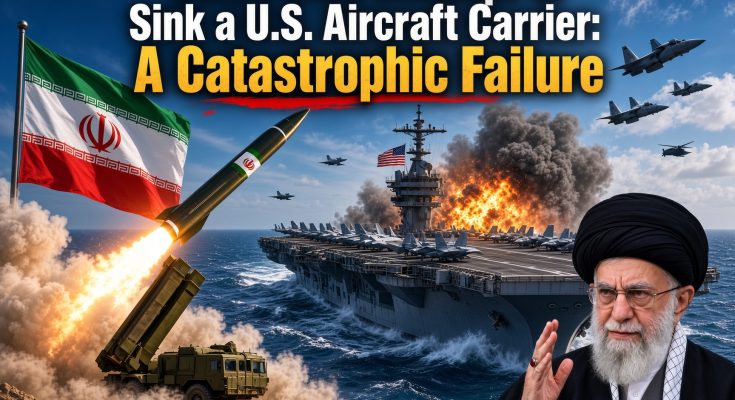
In the scenario, Iranian coastal missile batteries, positioned along the northern shore and partially concealed by terrain and emission control, prepare a coordinated salvo. Thirty-two anti-ship missiles of varying types are readied for near-simultaneous launch against a U.S. aircraft carrier operating with its escorts in the strait. The carrier strike group represents roughly 4,700 personnel. From the moment of launch, the missiles would require approximately three minutes and forty seconds to reach the carrier’s estimated position if they followed an unimpeded ballistic or sea-skimming profile. Iranian planners in the scenario calculate that the combination of numbers, mixed trajectories, and electronic interference will saturate or degrade the defending force’s ability to protect the high-value unit.
Detection begins almost immediately. Aegis-equipped destroyers and cruisers maintain continuous radar coverage of the surrounding airspace and surface. Within seconds of the first launches, the group’s integrated air-and-missile defense network classifies the inbound tracks and begins engagement. Interceptor missiles are fired from the escorts in rapid succession. Some of the Iranian missiles are defeated at longer range by mid-course interceptors; others that penetrate closer are engaged by terminal-phase systems. Not every missile is destroyed in flight, yet the layered architecture—long-range, medium-range, and close-in—reduces the number of warheads that remain on a threatening trajectory. Soft-kill measures, including decoys and electronic countermeasures, further complicate terminal guidance for the remaining threats.
Simultaneously, an electronic-warfare contest unfolds across the electromagnetic spectrum. Iranian forces attempt to jam or spoof the strike group’s search and fire-control radars and to disrupt data links. U.S. platforms respond with their own electronic-attack and electronic-protection systems, preserving sufficient situational awareness for continued tracking and engagement. The contest is largely invisible yet decisive: even partial success in maintaining track quality allows the defense to allocate interceptors efficiently and to update the carrier’s own protective posture.
While the air-defense engagement continues, the strike group and supporting forces initiate a counterstrike. Submarines and surface ships launch Tomahawk land-attack cruise missiles against pre-planned targets associated with the coastal missile batteries, command nodes, and supporting radar or communication sites. Additional assets, including carrier-based aircraft if already airborne or rapidly launched, contribute to the suppression effort. The response is not instantaneous; it requires target confirmation, weapon assignment, and flight time. In the scenario, however, the combination of defensive attrition of the inbound salvo and the rapid degradation of the attacking force’s ability to generate follow-on launches produces a decisive shift within roughly thirty-two minutes of the initial Iranian launch order.
By the end of that interval, the majority of the original anti-ship missiles have been intercepted or have missed, the coastal batteries have sustained strikes that limit their remaining capacity, and the carrier remains operational. Iranian forces in the scenario experience a rapid collapse of the intended operation: the initial salvo fails to achieve a mission-killing hit, and the subsequent U.S. response removes or degrades the means of continued attack. The outcome illustrates a recurring feature of contemporary naval warfare—initial offensive surprise can be blunted by layered, networked defenses, after which the defender’s capacity for precision retaliation can impose disproportionate costs.
Several broader observations follow from the constructed sequence. First, saturation attacks against a modern carrier strike group face a multi-tiered defensive architecture whose individual components are mutually reinforcing. Success requires not merely launching large numbers of missiles but also surviving the defending force’s electronic and kinetic responses long enough for those missiles to complete their flight. Second, the electromagnetic domain is integral to both offense and defense; control or denial of sensors and communications can determine whether kinetic weapons are employed effectively. Third, the speed of escalation means that decision timelines compress dramatically. In the scenario, the entire exchange from first launch to decisive degradation of the attacking capability unfolds in just over half an hour, leaving little room for real-time political intervention once weapons are airborne. Finally, the strategic consequences extend well beyond the immediate tactical result. An unsuccessful attack that also invites heavy retaliation can leave the initiator in a worse position than before the engagement began, both militarily and diplomatically.
The Strait of Hormuz will continue to concentrate naval forces and attention because of its economic importance and constrained geography. Contingency analyses of the kind sketched here highlight the premium placed on integrated air and missile defense, electronic warfare resilience, and the ability to generate timely counterforce options. They also underscore the risks of assuming that an initial strike will remain unanswered or that defensive systems can be overwhelmed by numbers alone.
Disclaimer: This content is a fictional scenario created for educational, analytical, and storytelling purposes only. The events, timelines, numbers of missiles, personnel figures, and outcomes described do not represent real historical events and should not be interpreted as factual reporting, intelligence information, or official military records. The narrative draws on publicly known military concepts and speculative analysis presented in dramatic form to illustrate strategic decision-making and escalation dynamics. It does not promote violence, hatred, or conflict against any nation, military, or group, nor does it reflect the views of any government or armed force. Any similarities to real events, locations, or individuals are coincidental and used solely for illustrative purposes.