Federal and local law enforcement agencies are now working together to determine whether the incident was an isolated weapons case or something more serious.
The arrest triggered an immediate response from multiple agencies responsible for protecting the president, prompting investigators to examine the suspect’s movements, statements and the items recovered during the investigation.
Although officials say there is no confirmed plot at this time, they continue to describe the case as active.
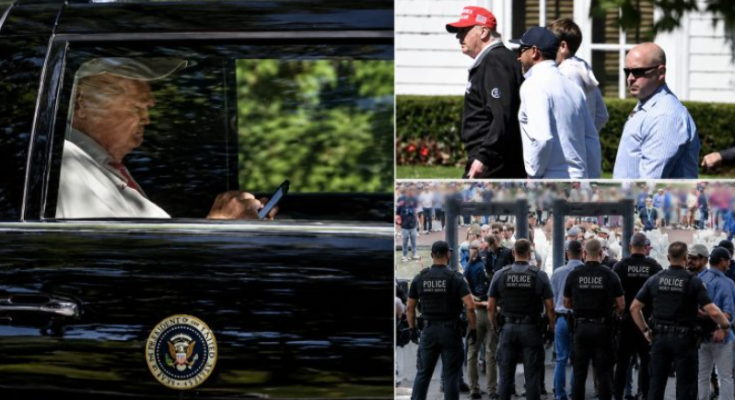
An armed man was arrested outside Trump National Golf Club in Rancho Palos Verdes, California, after federal agents reported suspicious activity on the property before President Donald Trump’s scheduled visit, according to the Los Angeles County Sheriff’s Department.
The arrest occurred Sunday, two days before Trump arrived in Southern California for a Republican National Committee dinner at the golf club after traveling aboard Air Force One.
According to a federal law enforcement source familiar with the investigation, the U.S. Secret Service is examining whether the suspect posed a threat to the president.
The source told CNN there is currently no indication that the suspect was actively planning an attack on Trump but emphasized that investigators are continuing to evaluate the evidence.
Authorities identified the suspect as 38-year-old Jeanine John Taele of Downey, California.
The Los Angeles County Sheriff’s Department said Taele was already under investigation by the El Segundo Police Department in connection with a separate robbery case before his arrest at the golf club.
Investigators said federal agents first noticed Taele during a security assessment conducted Friday before the president’s visit.
According to the U.S. Department of Justice, agents observed Taele walking around the golf course while wearing an earpiece and taking photographs and videos of federal agents and their security operations.
Officials said Taele left the property but returned Sunday, when he approached federal agents and allegedly claimed he worked for the U.S. State Department and was part of a security detail.
Authorities said Taele also informed officers that he had a loaded firearm inside his vehicle.
President Donald Trump speaks to the media wearing a hat that reads, “Trump Was Right About Everything!,” during a visit to The People’s House: A…
After searching the vehicle, deputies arrested him on state charges that included carrying a concealed firearm and possessing prohibited ammunition.
On Tuesday, Taele pleaded not guilty to four state charges, including second-degree robbery related to an alleged November 2025 incident and three weapons offenses connected to his August 2 arrest.
Court records show a judge set his bail at $250,000, ordered him not to possess firearms, directed him to stay away from Trump National Golf Club and required him to remain in California while the case proceeds.
Federal prosecutors also filed a criminal complaint charging Taele with possessing an unregistered short-barreled rifle, a felony offense punishable by up to 10 years in federal prison if convicted.
He is expected to make his initial appearance Wednesday in federal court in Los Angeles.
As part of the investigation, members of the FBI’s Joint Terrorism Task Force executed a search warrant at Taele’s residence on Monday.
According to the sheriff’s department, investigators recovered what they described as an illegally modified AR-style rifle, a .45-caliber pistol, body armor, high-capacity magazines, ammunition, radio signal devices and several notebooks containing what officials called “concerning statements.”
President Donald Trump gestures as he speaks during a press briefing in the Brady Briefing Room at the White House in Washington, DC, shortly after a…
“While we are still investigating the motives of this individual, we are thankful he was apprehended before the President’s visit,” First Assistant U.S. Attorney Bill Essayli said in a statement.
Essayli added that federal and local law enforcement “stepped in early and prevented what could have been a dangerous situation from occurring,” CNN reported.
The FBI, Secret Service and local law enforcement agencies continue to investigate the incident, and officials have indicated that additional charges could be filed as more evidence is reviewed.
A MASSIVE FRAUD? — The Chilling Birthdate Mystery That Could Put Ilhan Omar’s U.S. Citizenship at Risk
A decades-old question about Ilhan Omar’s birth year has suddenly taken on new significance—and the stakes could extend far beyond political controversy. Federal investigators are examining immigration records tied to the Minnesota congresswoman’s childhood, raising questions about how she obtained U.S. citizenship and whether information submitted during that process was accurate.
The investigation has intensified after federal agents searched Omar’s Washington, D.C., residence in October 2026. Reports indicate that investigators are examining whether Omar or her late father misrepresented her age on immigration paperwork decades ago. At the center of the inquiry is a critical question: Did her age affect her eligibility to obtain citizenship through her father?
For Omar, the issue could become one of the most consequential legal challenges of her political career. But the allegations remain unresolved, and the existence of an investigation does not establish that fraud occurred.
The Birthdate Discrepancy at the Center of the Investigation
Omar was born in Somalia and arrived in the United States in 1995 after spending time in a refugee camp in Kenya. She has said that she became a U.S. citizen in 2000 through her father’s naturalization process while she was still a minor.
According to reporting by The Washington Post, investigators are examining allegations that Omar or her father may have provided an inaccurate age on immigration documents. The question is whether she was under 18 when her father obtained citizenship—a distinction that could have affected the legal process through which she became a citizen.
The dispute partly stems from conflicting public references to Omar’s birth year. Her official biographical information has listed 1982, while some earlier public records listed 1981. Omar and her representatives have described efforts to correct the discrepancy as attempts to fix inaccurate information, not to conceal her identity or immigration history.
That difference of one year has become central to renewed scrutiny because age can matter under immigration law. Yet a discrepancy in public records, by itself, does not establish that someone deliberately submitted false information to federal authorities.
Investigators would need evidence about the original immigration documents, the circumstances in which they were completed, and the legal significance of any inaccurate information before drawing conclusions about wrongdoing.
Why the Question Could Affect Her Citizenship
The potential legal consequences explain why the inquiry has attracted national attention.
Omar has said that she obtained citizenship through her father when she was a minor. If investigators believe that the information used in that process was inaccurate, they may examine whether she qualified for that route to citizenship at the time.
That does not automatically mean her citizenship is invalid.
A federal investigation is not the same as a court ruling, and an allegation is not proof of fraud. Any effort to revoke naturalized citizenship would require a legally sufficient basis and formal proceedings under applicable law. Authorities would have to establish the relevant facts and meet the required legal standards.
The distinction is especially important in Omar’s case because the alleged paperwork dates back decades. Investigators must determine what the original records show, who supplied the information, whether any discrepancy was intentional, and whether the evidence supports a legal challenge to her citizenship.
The consequences could be serious if authorities ultimately established grounds to pursue denaturalization. But deportation is not an automatic result of a search warrant, a subpoena, or an unproven allegation.
Federal Search Raises the Stakes
The inquiry moved into a more visible phase on October 12, 2026, when federal agents searched Omar’s Washington residence under a judicially authorized warrant.
The Justice Department confirmed that Homeland Security Investigations carried out the search as part of an ongoing federal investigation. Subsequent reporting said investigators were examining possible irregularities in immigration paperwork and had issued subpoenas seeking testimony from relatives and other individuals.
The search intensified an already bitter political dispute. Omar is a prominent Democratic lawmaker and a frequent target of President Donald Trump’s criticism. The timing, just weeks before the November 3 midterm elections, has prompted Democrats to question whether federal law enforcement is being used to target a political opponent.
The administration’s position and the political criticism surrounding the case do not resolve the underlying factual questions. The key issue remains whether investigators can substantiate the allegations using reliable evidence.
Omar has rejected the investigation as politically motivated and said she would not be silenced. Her office has maintained that she did nothing wrong.
At the time of the reports, authorities had not publicly established that Omar committed immigration fraud, and the search itself was not a finding of guilt.
A Controversy That Has Followed Omar for Years
The current investigation has revived accusations about Omar’s immigration history that have circulated in conservative media and political debates for years.
Those claims have repeatedly become part of the broader political fight over her background, policy positions, and criticism of Republican leaders. But the existence of longstanding accusations does not make them true, just as a new investigation does not independently validate every allegation previously made against her.
The latest inquiry is more consequential because it involves federal investigators examining records and executing a search warrant. Even so, the public still needs to distinguish between what officials have confirmed, what unnamed sources have reported, and what political figures have alleged.
The evidence will matter more than the volume of public commentary. Original immigration records, testimony from people with direct knowledge, and any formal findings or court filings could help clarify what happened decades ago.
Until those details are established, the birthdate question remains an investigative issue—not proof of a massive fraud scheme.
What Happens Next?
The central question is whether investigators can establish that inaccurate information was knowingly submitted and that it materially affected Omar’s path to citizenship.
Several outcomes remain possible. Investigators could find evidence supporting further legal action, uncover information that fails to establish wrongdoing, or conclude that the available records do not support a case. The public record has not yet established which outcome will occur.
If the government seeks to revoke Omar’s citizenship, it would face legal requirements that cannot be bypassed simply because the case involves a high-profile elected official. Any eventual challenge would depend on the evidence, the applicable law, and the outcome of formal legal proceedings.
For now, the story is not that Omar has been deported or that her citizenship has been revoked. It is that a federal investigation has placed a decades-old question about her age and immigration paperwork under renewed scrutiny, with potentially significant consequences if the allegations are substantiated.
The unanswered question is whether the records will ultimately support the government’s suspicions—or whether the controversy will remain another unresolved chapter in one of Washington’s most politically charged disputes.