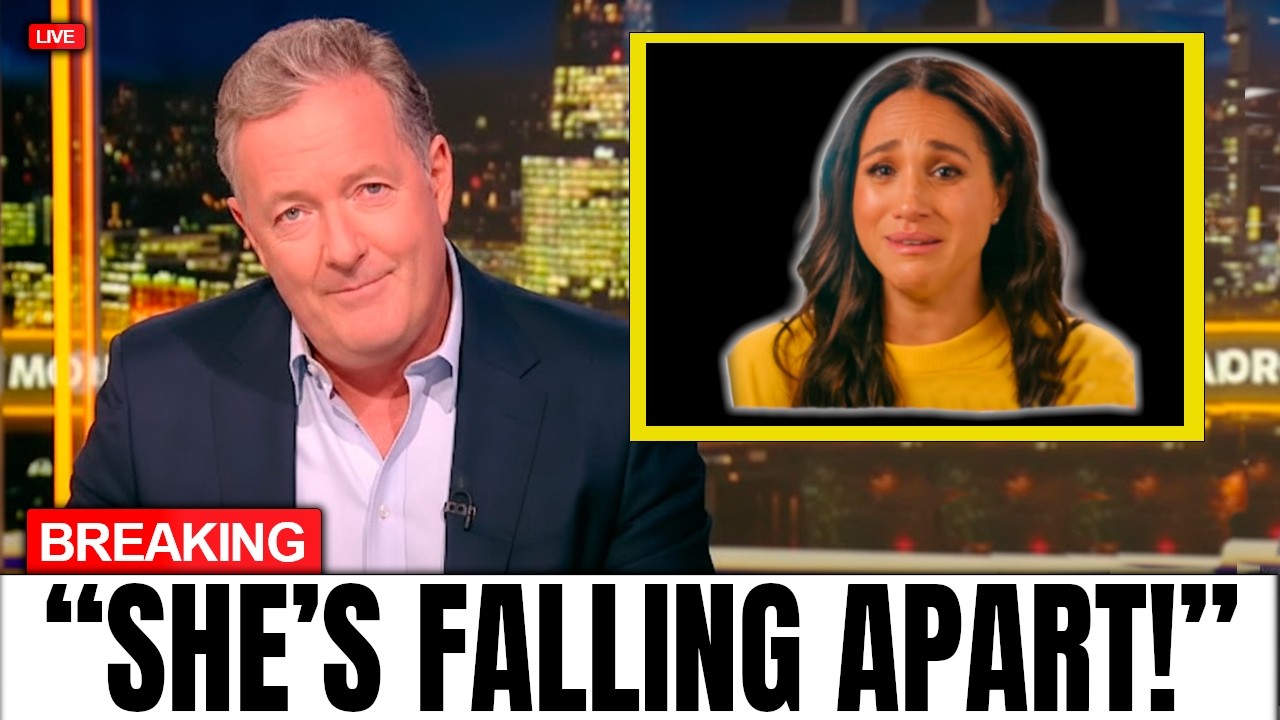
The video, titled “Piers Morgan EXPOSES 10 Shocking Truths About Meghan’s Final Downfall,” walks through a countdown from ten to one, mixing lifestyle-brand embarrassments, diplomatic missteps, a live American immigration case and a bullying inquiry that was never publicly resolved. The through-line, as the commentary frames it, is not scandal in the tabloid sense but a slow accumulation of documented detail that the wider press is said to be quietly catching up with.
Supporters of the Sussexes would contest that reading sharply, arguing that the segment repackages old grievances as vindication, and that its sourcing leans heavily on commentary rather than adjudicated fact. The transcript does not present a single newly broken news event; instead it assembles a sequence of already-reported episodes and asks the audience to read them as one pattern.
That interpretive move is the real subject of the piece, and it deserves examination claim by claim. The countdown opens with what the segment calls the contradiction Meghan cannot explain, built around two statements made roughly three weeks apart.
In a long, softly lit video conversation with her friend Jaime Kern Lima, staged with two rocking chairs and warm lighting, the Duchess is said to have described her life as the happiest and most fulfilled she had ever known, praising her children, her marriage and her California life. Weeks later, in late April, she is said to have posted a quote about ending the hardest seven years of your life, and to have shared it twice on the same day to her several million followers.
Piers Morgan, by his own published commentary, reacted within hours, performing what the segment calls the most basic piece of journalistic arithmetic: counting back seven years from April 2025 to 2018, the year of the royal wedding. The commentary’s central question is whether both statements can be true at once, and it answers with the assertion that they cannot even sit in the same sentence without one looking like a performance.
This is a rhetorical test rather than a factual finding, and critics of the segment have noted that personal happiness and accumulated hardship are not mutually exclusive in ordinary human experience. The framing nonetheless captures something potent about modern celebrity: the demand that a public figure’s emotional register remain consistent across years of carefully produced content.
The second claim concerns what the commentary calls the queen who never was, arguing that Meghan Markle formally walked away from royal duties in January 2020 but continues to be surrounded by imagery and language of monarchy. It points to astrologers and influencers in her orbit posting about her reigning again, and to a wider Sussex content apparatus said to build a halo of royal aesthetics around a woman who surrendered the role.
Piers Morgan has repeatedly cited the moment she described herself as a princess on a podcast in conversation with young girls, calling it one of the most revealing things she has ever done. The argument advanced is that the commercial proposition depends on that imagery: the audience for lifestyle products is reached most effectively by leaning into the institution she publicly left.
The polling evidence cited in the segment is impressionistic rather than statistical, and royal commentators across the spectrum have disagreed for years about how much of the Sussex brand rests on residual titles. What is not in dispute is the tension itself, which even sympathetic observers have acknowledged: it is genuinely difficult to monetise proximity to an institution while simultaneously casting it as cruel and cold.
Objectivity requires saying plainly that this is an argument about branding and authenticity, not a legal or constitutional question. The third item is the Serena Williams unboxing, which the segment treats as a market verdict delivered by the one person least likely to deliver one.
Meghan’s latest As Ever collection, according to published product listings cited in the commentary, included a candle priced at sixty-four dollars and gourmet chocolates at forty-two dollars per package in a powder-blue box. A promotional package was sent to Serena Williams, her most famous and most loyal celebrity ally, who filmed an unboxing video for millions of followers.
On camera, by the segment’s account, the chocolates arrived smashed and stuck together, and Williams admitted she does not particularly like chocolate, tried one anyway, and called them beautiful while visibly struggling. She then attempted to read the candle’s scent notes aloud, could not pronounce them, and closed with “Looks good, I love you, Meghan,” a line the commentary treats as the moment the enterprise announced itself rather than the product.
Beneath the viral clip, the segment cites reports that the Duchess had sold a single-digit number of items on a luxury clothing resale platform, that some customers received candles with no wicks, and that original jam launch labels reportedly peeled before reaching buyers. It contrasts that record with reported arrangements valued at around one hundred million dollars with Netflix and around twenty million dollars with Spotify, framing the gap as the marketplace’s cold language.
Lifestyle brands routinely suffer launch mishaps, and single viral videos are imperfect evidence, but the commentary’s point is cumulative rather than forensic: the gap between valuation and execution is the story. The fourth claim moves to geopolitics and the Ukraine speech, which the segment treats as categorically different from the branding disputes because it concerns power rather than perception.

Prince Harry is said to have travelled to Ukraine as a private citizen, without mandate from Britain, the palace or the government, sat alongside heads of government and former prime ministers, and called for American leadership on the conflict. That speech, the commentary argues, publicly contradicted Donald Trump’s stated position, and Piers Morgan described it as infantile, immature and irresponsible.
Asked about it publicly, Trump is said to have responded that Prince Harry does not speak for the United Kingdom, which the segment reads as confirmation that the intervention landed badly. The genuinely serious element, by this framing, is timing: King Charles was preparing for a major United States state visit, a diplomatic engagement requiring precision and political neutrality, and the speech dropped only days before the king stood at his own podium on American soil.
The palace and the British government are said by every available signal to have been furious, though no formal statement confirming that anger appears in the public record as described. The constitutional principle is real and long-established: members of the royal family do not freelance on geopolitics, and the commentary’s point is that a title retained in brand terms carries obligations that cannot be selected à la carte.
The fifth item is the omission heard around the world, a moment the segment says passed in seconds but carried the weight of a verdict. During the king’s United States state visit, in front of the president and a global audience, Charles is said to have spoken about American cities bearing family names: Charleston, named after King Charles II, and Williamsburg, named after King William.
He did not mention Harry, on one of the biggest stages of his reign, in one of the most carefully scripted moments of his public diplomacy. Piers Morgan called the omission deliberate, public and unmistakable, a signal rather than an oversight, delivered to an audience of hundreds of millions and impossible to walk back.
Placed alongside the treatment of the former Duke of York, whose titles, patronages and royal residence connections were formally removed with the king’s support, the segment raises the question of whether similar institutional steps might await Harry. The comparison is contested: Andrew’s position collapsed around associations with a convicted criminal and a private disgrace, whereas Harry’s offences, by the commentary’s own account, have been public attacks on the institution itself, including a memoir, a documentary series and broadcast interviews.
Royal commentators close to the palace are said to have described the question of the nuclear option as genuinely live, a reported framing rather than a confirmed plan. What can be said with confidence is that omission in a scripted royal speech is almost never accidental, and the interpretive battle over what this one meant is now part of the public record.
The sixth claim concerns the friendship playbook, which the commentary insists should be read as pattern rather than gossip. It lists the people described as having been removed from Meghan Markle’s life: her father’s side of the family, her father himself since the wedding, early royal-years advisers, and multiple staff members who left in circumstances that generated a formal bullying inquiry.
The most concrete element is a 2018 email from Jason Knauf, then communications secretary at Kensington Palace, said to describe in writing a pattern of behaviour towards staff, with specific language about people being bullied out of their positions and their confidence undermined. That is a named senior employee with a documented paper trail, not an anonymous source, and it remains the most institutionally serious allegation attached to the Duchess’s name.
The commentary contrasts that record with content positioning her as an authority on friendship and human connection, a juxtaposition Piers Morgan has described in characteristically blunt terms. It also cites the wider churn of senior communications professionals through the Sussex operation, including a first United States chief of staff who departed within roughly a year and a Democratic-party recruit who moved on.
The pattern of departures is documented across serious royal reporting, though attributing it to a single cause is contested; what the segment argues is that the consistency itself is the evidence. The seventh item is the visa file, which the commentary calls the quiet danger and, in its own framing, the most genuinely serious legal thread in the entire story.

The Heritage Foundation, a long-established conservative policy organisation in Washington, filed a Freedom of Information Act request seeking Prince Harry’s United States immigration records. The basis was his own memoir, Spare, published in 2023, in which he acknowledged past use of cocaine, cannabis and psychedelic mushrooms, while past drug use is a standard question on American visa applications.
In September 2024, District Judge Carl Nichols ruled for the Department of Homeland Security, finding the Duke’s privacy interest outweighed the public interest in disclosure. In March 2025, the same judge reversed course and ordered the department to file redacted versions of previously private documents publicly by the end of 18 March, and more than eighty pages of filings and transcripts were duly released.
According to reporting cited in the segment, the released material did not include Harry’s actual visa application form, and large sections were blacked out; the government’s published position was that there was no evidence he received favourable treatment. An attorney for the Heritage Foundation stated in open court that lying on an immigration form gets you deported, a real on-the-record statement, and the case by every published indication remains ongoing.
The precision matters here: the documents do not establish wrongdoing, but they also do not close the question, and the gap between those two facts is precisely what keeps the story alive. The eighth claim is the financial reckoning, which Piers Morgan has long argued would ultimately be the truth that mattered most.
Published reporting cited in the segment gives Harry and Meghan a runway of roughly five years before what one source described as a lifestyle adjustment they cannot brand their way out of. It points to Diana’s inheritance, received in part at a younger age, and the Queen Mother’s bequest, received on a later milestone birthday, as significantly drawn down.
The headline Netflix arrangement is said to have ended in its original framing, Spotify is done, the As Ever brand is described as far short of what the present operation requires, the Invictus Games is a charity rather than a revenue stream, and the Archewell Foundation is said to have closed at the end of 2025. The detail the segment treats as a quiet punchline concerns Montecito: when you buy a house in one of America’s wealthiest postcodes at the reported price, the next thing you do is renovate, and reporting attributed to royal commentator Tom Sykes suggests the Sussexes moved in as they found it, last properly updated more than a decade ago.
Neighbours can read that signal, the commentary argues, and five years of reserves is an estimate rather than a forecast. Some of these financial assertions rest on unnamed sources and should be treated as reported claims rather than audited accounts, but the direction of travel described is consistent with a broader consensus that the original commercial architecture has not been replaced.
The ninth item is the bullying files and the institution that did not let the matter slide, which the commentary describes as arguably the most institutionally serious allegation ever attached to Meghan Markle’s name. In 2021, Kensington Palace announced a formal investigation into bullying allegations made against the Duchess by multiple members of staff, days before the Oprah Winfrey interview was broadcast.
An institution that goes to extraordinary lengths to avoid public conflict had, by this account, received enough credible information to warrant an inquiry, and the timing was widely read as significant. The findings were never publicly released; the palace decided they would remain confidential, and the Sussex side characterised the announcement as a coordinated effort to damage Meghan’s image ahead of the broadcast.
The underlying email trail did not evaporate, and Jason Knauf’s 2018 written concerns remain in the public record, with two staff members specifically described in wider reporting as having been bullied out of their roles. The commentary’s conclusion is that a palace protecting the monarchy above almost all else decided in 2021 that the allegations were serious enough to announce publicly, which in its framing is the opposite of nothing.

Critics of the segment note that an inquiry without published findings cannot be treated as a verdict, and that is a fair objection; what remains beyond dispute is that the question has never been formally answered in public. The tenth and final claim is the one that cost a career, the statement Piers Morgan made the morning after the Oprah Winfrey interview in March 2021.
He said plainly that he did not believe her, adding in his on-air language that he would not believe her if she read him a weather report, and refused to retract despite losing his position. The broadcast generated roughly forty thousand formal complaints to Ofcom, one of the highest single complaint counts in the regulator’s recent memory, and the Duchess of Sussex was understood at the time to have made her own personal complaint to the broadcaster.
Within twenty-four hours he had walked off the Good Morning Britain set; within two days he had departed the programme entirely. The commentary then performs its closing move: it places the week’s statements side by side, from the happiest she has ever been to the hardest seven years of her life, alongside earlier claims about being the most trolled person in the world, the “reigning again” imagery, the Oprah interview, the Netflix series and four hundred pages of Spare.
The question it asks is how many of those statements can be simultaneously true in the ordinary sense that a single life can hold them all at once, and its answer is that they collapse against one another. The deeper argument, attributed to Piers Morgan’s published analysis, is that the core problem is not provable lies but an identity that has never been settled: victim or victor, duchess or celebrity, private mother or global brand.
What distinguishes this week’s run, the segment insists, is that none of the vindications arrived through tabloid speculation. Each is said to rest on documented reporting, named sources, federal court filings, official palace announcements, or Meghan’s own published words sitting next to her other published words.
Not everyone accepts that characterisation; Sussex supporters point out that immigration proceedings establish nothing yet, that financial estimates rest on unnamed briefings, and that editorial omission in a royal speech is interpretation rather than proof. The visa case is live, the title question inside the palace remains unresolved by every available indication, and the financial runway is narrowing without having closed.
There is, by any honest reading, still time for decisions, course corrections or a meaningfully different path from either Harry or Meghan. The wider takeaway the commentary offers is about standard rather than verdict: a five-year argument that the facts would eventually do the work that opinion could not.
Whether that is vindication or simply the long half-life of a very public feud is a question the audience will keep answering for itself, long after the countdown ends. The story that began at a royal wedding seven years ago is not over, and the next chapter, by the reporting available, will be written in court filings rather than in tabloids.